Growth of single gold
nanofilaments at the apex of conductive Atomic
Force Microscope tips
S. Bakhti, N. Destouches, C.
Hubert, S. Reynaud; F. Vocanson; T. Ondarçuhu,
T. Epicier, Nanoscale (2016)
Thanks
to a nanoscopic interaction scale due to a nanosized
tip apex, atomic force microscopy (AFM) has given rise
to a wide range of derived physical and chemical
characterization techniques of surfaces. Most of these
techniques involve the use of metallic or metallized
tips to allow electric type measurements that give
access to sample properties such as conductivity,
electric forces or surface potentials. Conductive tips
are also used to improve optical spectroscopies like
Tip-Enhanced Raman. For all these applications, one of
the main challenges lies in an improvement in the
spatial resolution. This target is mostly achieved by
manufacturing or functionalizing AFM tips with
improved mechanical and geometrical characteristics
that permit the detection limits to be pushed. This
paper describes a fast and one-step technique to grow
single gold filaments at the apex of commercial
conductive AFM tips. It is implemented with an atomic
force microscope in air with a high relative humidity
at room temperature and is based on a bias-assisted
electro-reduction of gold ions directly at the tip
apex (Fig. 6a). The technique requires only ad hoc
substrates made of a mesoporous silica layer loaded
with gold salt deposited on a conductive electrode. It
leads to the growth, at the tip apex, of filaments
whose length can be monitored and controlled during
the growth between tens and hundreds of nanometers and
whose radius of curvature can be as low as 3 nm (Fig.
6b-c). Made of polycrystalline gold nanostructures,
the filaments are chemically and mechanically stable
and conductive.
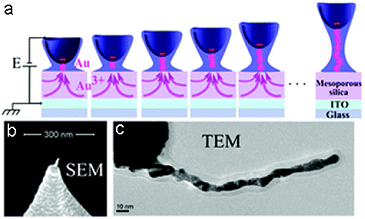
Fig.
(a) Sketch of the filament growth mechanism. (b) SEM and (c)
TEM images of gold filaments grown at the apex of AFM tips
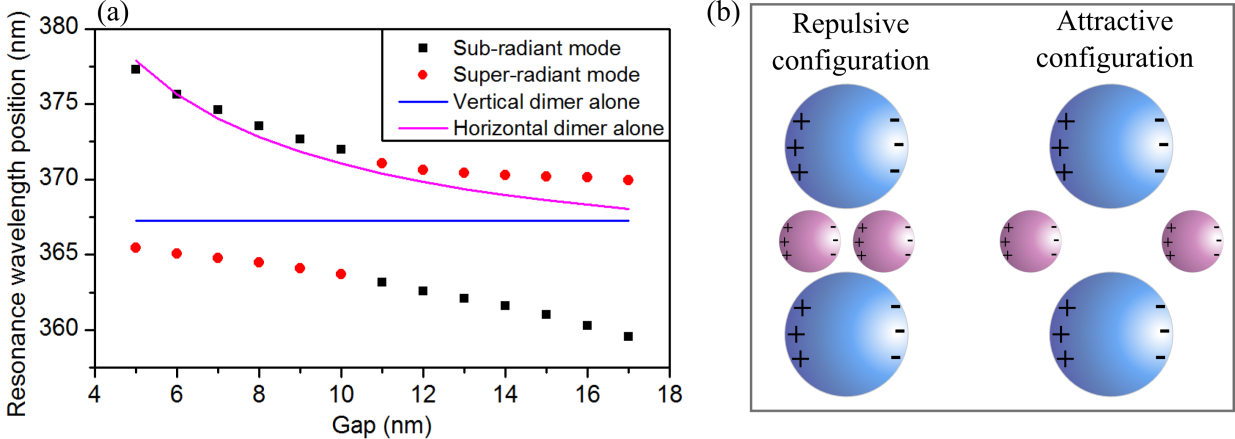
Coupled mode modeling to
interpret hybrid modes and Fano resonances in
plasmonic systems
S. Bakhti, N. Destouches, A.V.
Tishchenko, ACS Photonics, 2 (2), 246–255 (2015)
By
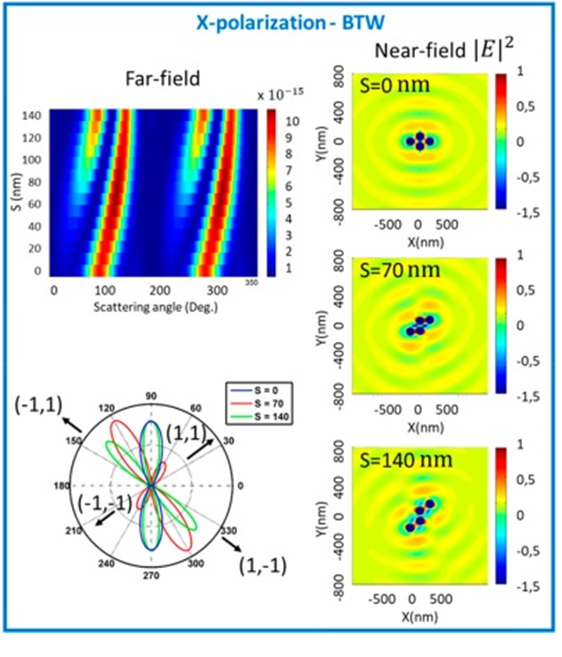
generalizing the concept of extinction cross-section to
complex valued extinction cross-section we analyze the
coupling between plasmon modes in metallic dimers or
quadrumers. The partial complex extinctions of single
particles within an ensemble provide information about
the relative oscillations of resultant dipolar moments
of the particles. When particles are illuminated with a
constant phase of the incident plane wave (Fig), the
phase difference between their scattered far-field (and
hence between their partial complex extinction) results
from a phase difference in their dipolar moments.
Complex extinction can then be conveniently used to
characterize the radiative behavior of each particle of
a coupled system. Identifying the phase information in
the field scattered by subsets of the whole plasmonic
system allows to infer the formation of sub-radiant or
super-radiant hybrid modes. We also propose a
phenomenological modeling based on the use of coupled
mode equations to deduce from rigorous calculations a
quantitative estimate of mutual coupling coefficients
when only two modes interfere. These coefficients
determine the spectral position of hybrid modes.
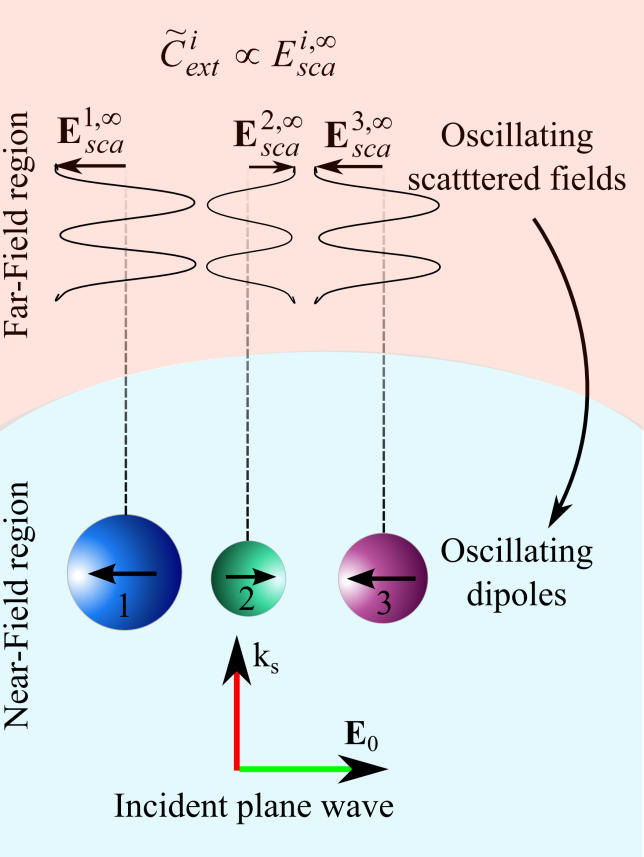
Fig.
Schematic representation of phase relations between partial
scattered fields and oscillating dipolar moments of a system
of particles.
This
approach is applied to two interacting silver spheres; the
parameters of the energetic diagram are calculated as a
function of the gap between spheres. In the case of two
identical spheres illuminated with a linearly polarized
light parallel or perpendicular to the dimer, only one
hybrid mode is excited and the phenomenological modeling can
apply to a four-particle system in which only two modes
interfere. The interaction between the modes of each dimer
gives rise to Fano-like resonances whose energetic diagram
is drawn as a function of the gap of one dimer. This diagram
exhibits a crossing behavior with an energy inversion that
is interpreted in terms of strong changes in Coulomb
interactions (Fig).
Fig.
5: (a) Energetic diagram of coupled and isolated dimers and
(b) an illustration of Coulomb interactions between the
particles for a small and a large gap of the horizontal
dipole.
Self-organized growth of
metallic nanoparticles in a thin film under
homogeneous and continuous-wave light excitation
N. Destouches, N. Crespo-Monteiro, G.
Vitrant, Y. Lefkir, S. Reynaud, T. Epicier, Y. Liu,
F. Vocanson, F. Pigeon, J. Mater. Chem. C, 2,
6256-6263 (2014)
Creating
the conditions so that matter naturally self-arranges
under a uniform excitation is a guarantee of efficient and
cost-effective processes. From a technological point of
view, the latter generally
come down to one-step processes. But the physico-chemical
mechanisms involved in self-organization of matter are
always multiple and interactive, and their modeling and
understanding remain usually delicate. This paper
demonstrates that there exist conditions so that a single
homogeneous continuous wave (cw) visible laser beam can
generate the growth of periodic arrays of metal
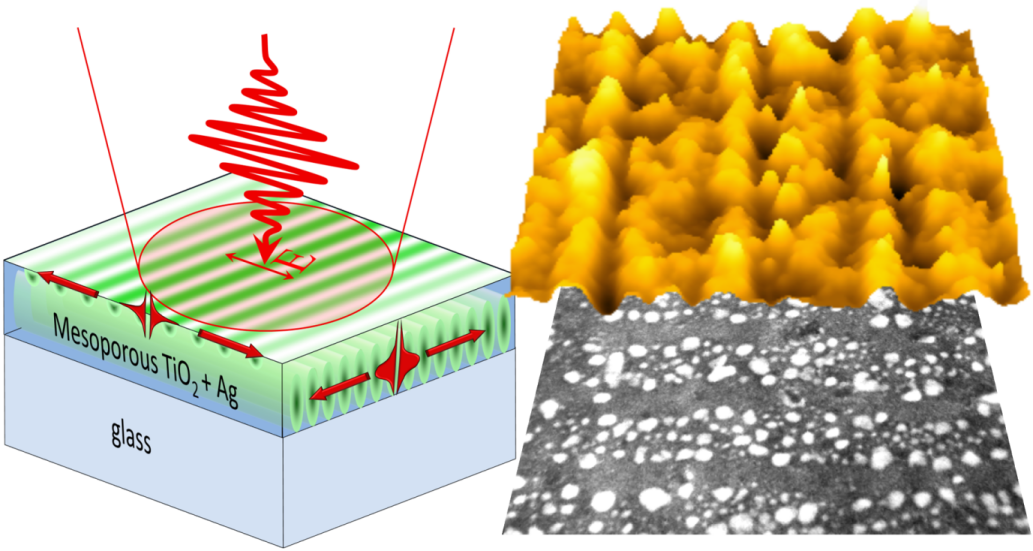
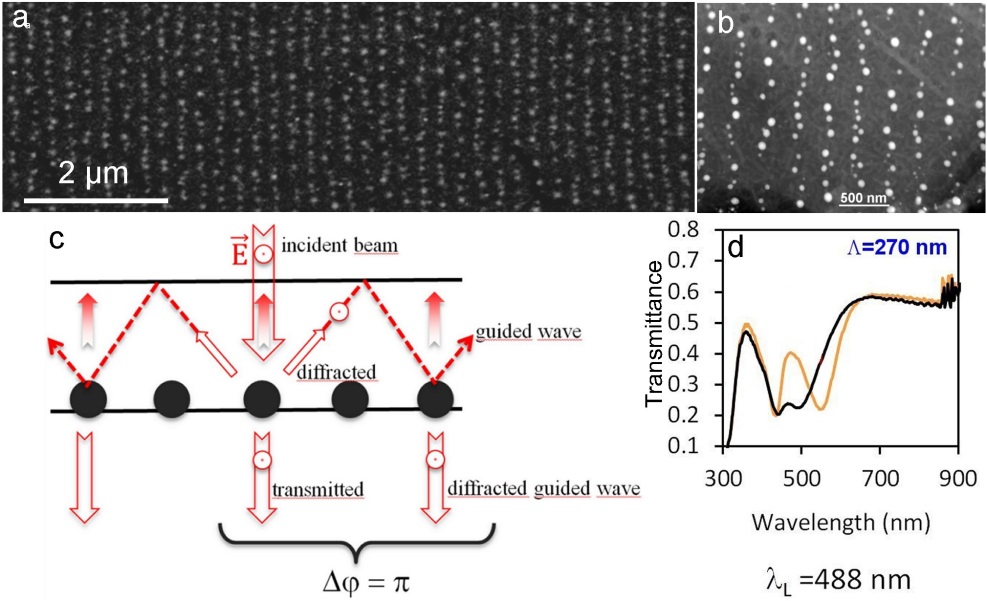
nanoparticles in a thin film (Fig. a-b). The film must
act as a waveguide, TiO2 is therefore useful for its high
refractive index. To grow silver nanoparticles under a cw
laser exposure, high enough atomic and ionic mobilities
must be reached and they are favored here by the low
initial density of the mesoporous film. Both laser-induced
oxidation of silver nanoparticles and thermally induced
reduction of silver ions are involved in the process. The
former is well known to be particularly efficient in
Ag:TiO2 systems and the latter, which is initiated by the
plasmon absorption of silver nanoparticles, requires few
nanoparticle seeds. According to experimental and
theoretical results we infer that self-arrangement
originates from interferences between the free-space
incident radiation and guided waves (Fig. 3c). Considering
the coupled-mode theory and a perturbation linked to the
changes in susceptibility resulting from the nanoparticle
growth under laser exposure, we proposed a model in which
the perturbation and the interference contrast are shown
to mutually self-enhance in a positive feedback loop and
grow exponentially. The buried nanoparticle grating
resulting from this complex but one-step process is shown
to perpetuate during dynamic exposure without need for
stabilization techniques. The formed nanostructures act as
waveguiding metallic photonic crystals in which plasmon
and waveguide resonances are coupled and exhibit a strong
dichroism (Fig. d). Their optical properties can easily be
tuned by controlling extrinsic and intrinsic parameters.
The technique appears therefore to be useful to produce
tunable
filters with controllable color output and opens
applications in polarization imaging, displays, security
or lighting.
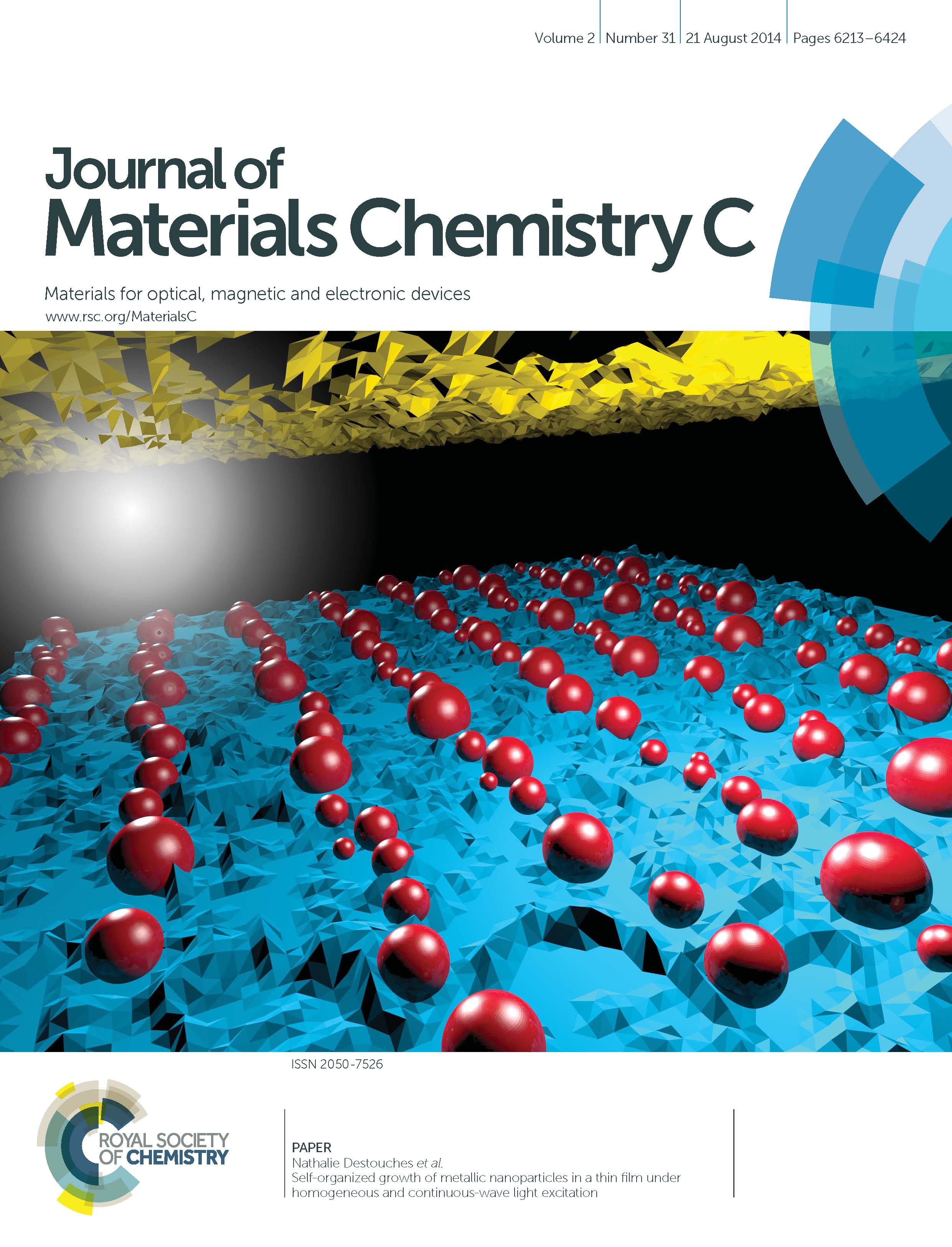
Fig. 3. Left: front cover of the journal. Right:
Scanning electron microscopy (SEM) (a) and high angle
annular dark field scanning transmission electron
microscopy (HAADF-STEM) (b) micrographs of
self-organized nanoparticle gratings. (c) Principle of the waveguide resonance. (d) Transmittance spectra under
normal incidence for parallel (orange curve) and
perpendicular (black curve) polarizations for a grating
produced at 488 nm wavelength whose period is 270 nm.
Only parallel polarization enables the waveguide
resonance excitation; this leads to a strong dichroism.
Reversible
and irreversible laser microinscription on silver containing
mesoporous titania films
Nicolas
Crespo-Monteiro,Nathalie Destouches, Laurence Bois, Fernand
Chassagneux, Stéphanie Reynaud, Thierry Fournel, Advanced
Materials, 22 (29), 3166-3170 (2010)
Silver
species adsorbed on colloidal TiO2 have been known
for a long time to exhibit photochromism. They reversibly
change color in response to light exposure. Under UV
illumination, i.e. at photon energy greater than the TiO2
band-gap (3.2 eV), the photogenerated electrons of titania
migrate towards the positively charged Ag(I) species and
reduce them, leading to the formation of silver nanoparticles.
The latter exhibit a grey-brown color caused by an
inhomogeneous broadening of their surface plasmon resonance,
which depends on the nanoparticle size, shape and close
environment. Reversibly, under visible light the material can
bleach or change color. This photochromism has been reported
recently on porous films composed of anatase TiO2
nanoparticles and silver nanoparticles and was shown to give
rise to various colors by a selective oxidation mechanism of
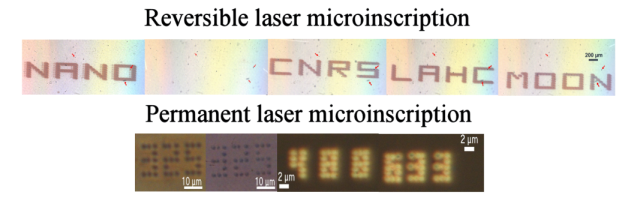
Ag nanoparticles. In this paper, mesoporous films of amorphous
titania loaded with silver exhibiting a reversible
photochromic behavior were used as writable or rewritable data
carriers. Monochromatic UV and visible radiations were used
respectively to repeatedly print and completely erase
micropatterns at the very same surface location demonstrating
the fully rewritable character of the thin film (Fig). Without
erasing step involving visible light intensities few orders of
magnitude greater than the everyday light intensity, the
UV-printed micropatterns were quite stable over time. We also
evidenced that laser-induced crystallization of the TiO2
mesoporous matrix occurs under high intensity continuous wave
(cw) laser exposure at various wavelengths from the UV to the
visible. This crystallization resulted in a local depression
on the film surface and was used to engrave permanent
micropatterns. As a result, simply varying the laser intensity
allowed to switch between permanent or erasable laser marking
on such coatings. Finally, it can be underlined that thanks to
the sol-gel technique used for the film preparation, such
photochromic coatings could be adapted on a large variety of
objects. The combination of a cw UV laser and a cw visible
laser offers then a simple tool to mark and eventually update
information on the objects.
Growth
Mechanisms and Kinetics of Photoinduced Silver Nanoparticles
in Mesostructured Hybrid Silica Films under UV and Visible
Illumination
Y.
Battie, N. Destouches, L. Bois, F. Chassagneux, A. Tishchenko,
S. Parola, A. Boukenter, Journal of Physical Chemistry C, 114
(19), 8679–8687 (2010)
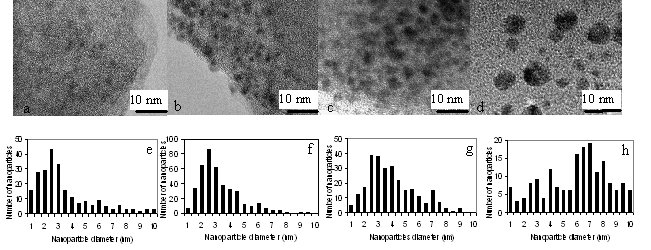
The growth of silver nanoparticles in
mesostructured hybrid silica films under laser illumination is
investigated by optical absorption spectroscopy and transmission
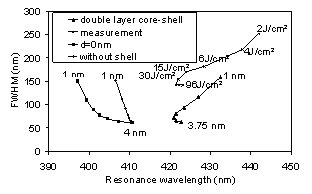
electron microscopy. At low laser doses in the UV range, a
blue-shift of the plasmon resonance is observed for increasing
particle size. This size dependence is interpreted on the basis
of the Mie theory assuming a two-layer core-shell model
resulting from the localization of the nanoparticles in the
block copolymer part of the film. At higher laser doses, the
observed red-shift of the resonance wavelength and decrease of
the absorbance level at resonance are attributed to the
formation of a high refractive index shell around the
nanoparticles that thickens slowly with the dose. The growth
kinetics of silver nanoparticles is also studied for different
illumination wavelengths in the UV and visible ranges.
Surprisingly, the nanoparticles also grow under visible
illumination. This is partly attributed to the release of
electrons by the degrading copolymer under illumination. The
decrease of the photoreduction process rate with the incident
wavelength increase has been evaluated quantitatively. We
propose an autocatalytic model that fits well with the
experimental data and suggest that the absorption of some
incident wavelengths by the generated small silver clusters
boosts their own growth.
Generation
of an ordered layer of silver nanoparticles in
mesostructured dielectric films
Y. Battie, N. Destouches, L. Bois,
F. Chassagneux, N. Moncoffre, N. Toulhoat, D. Jamon, Y.
Ouerdane, S. Parola, A. Boukenter, Journal of Nanoparticle
Research, 12, 1073-1082 (2010)
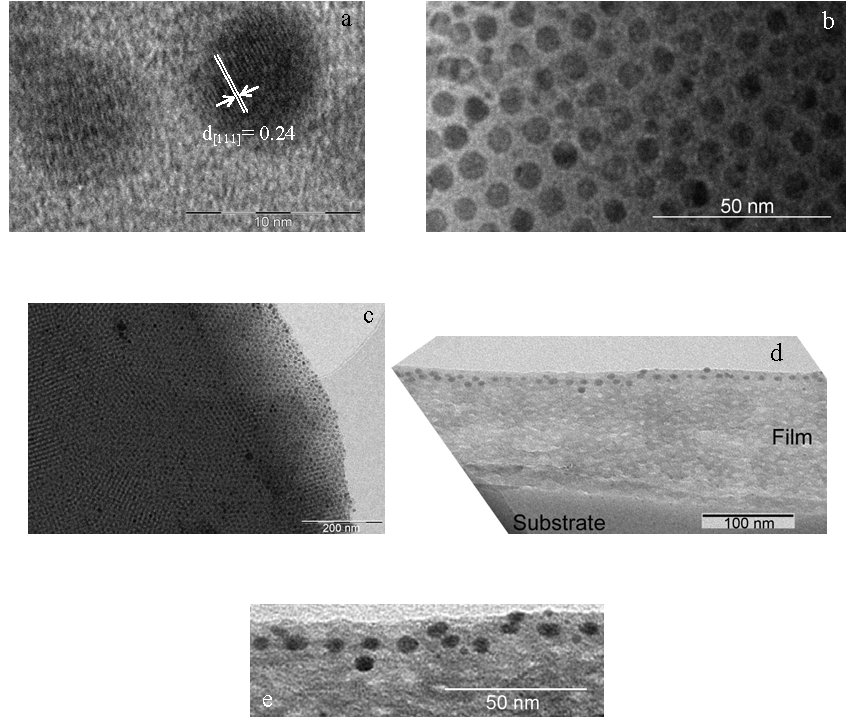
Mesostructured
organic–inorganic silica films containing AgNO3
are used as template to form ordered and dense layers of silver
nanoparticles embedded in a dielectric matrix. The hybrid silica
films are mesostructured by a triblock copolymer polyethylene
oxide-polypropylene oxide-polyethylene oxide ((PEO)106(PPO)70(PEO)106, F127) and
contain the silver precursor (AgNO3) which is dissolved directly
in the silica sol prior to deposition. The films are reacted
with a sodium borohydride solution (NaBH4),
which leads to the formation of a plane ordered network of
silver oblate nanoparticles with a narrow size distribution
located just below the film surface, and observed by
Transmission Electron Microscopy (TEM). The minor and major axis
lengths are equal to 5.3 ± 0.5 and 7.2 ± 0.6 nm, respectively.
The characterization of the mesostructured film before and after
the reductive treatment evidences that silver particles grow in
place of copolymer micelles in the upper layer of the
mesostructured thin film. Rutherford Backscattering Spectrometry
(RBS) measurements support the hypothesis that silver ions
initially dispersed in the film volume migrate toward the film
surface to form the monolayer of silver nanoparticles, organized
and stabilized by the copolymer micelles in the film. IR and
ellipsometric measurements are used to characterize the changes
in the hybrid copolymer-silica matrix.
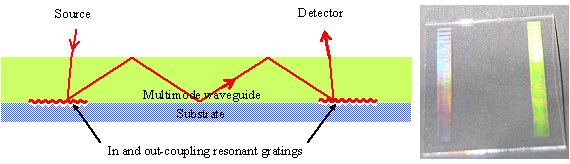
Efficient and
tolerant resonant grating coupler for multimode optical
interconnections
N.
Destouches, D. Blanc, J. Franc, N. Hendrickx, S. Tonchev, P.
Van Daele et O. Parriaux, Optics Express 15, 16870-16879
(2007)
More
than 60% overall coupling efficiency is achieved in the
demonstrator of an optical interconnect comprising an input
grating coupler, a multimode slab waveguide section and an
output grating coupler. The grating coupling strength is
enhanced by means of a leaky mode resonance. The efficiency of
the resonant grating coupler compares favourably with the
performances reported on mirror inserts.
Narrow band resonant grating of
100% reflection under normal incidence
N.
Destouches, J.C. Pommier, O. Parriaux, T. Clausnitzer, N.
Lyndin, S. Tonchev, Optics Express 14, 12613-12622 (2006)
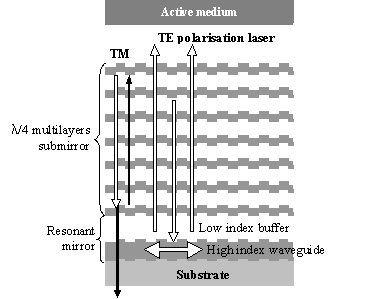
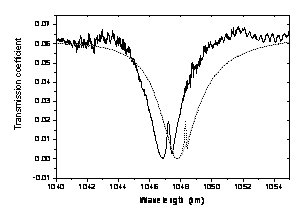
A
resonant grating mirror comprising a multilayer submirror and a
grating slab waveguide submirror exhibiting constructive mutual
reflection is shown experimentally to provide zero transmission.
Its reflection line width of less than 1 nm, its polarization
selectivity and low overall loss make the device usable as a
longitudinal mode filter in a disk laser in the 1000-1100 nm
wavelength range.
99% efficiency
measured in the -1st order of a resonant grating
N.
Destouches, A.V. Tishchenko, J.C. Pommier, S. Reynaud, O.
Parriaux, S. Tonchev, M. Abdou Ahmed, Optics Express 13,
3230-3235 (2005)
Unlike
their standard metallic counterparts, resonant
all-dielectric gratings are capable of diffracting an
incident free space wave with a diffraction efficiency of up
to 100% theoretically. They are composed of a dielectric
film and of a surface corrugation or film index modulation.
Since diffraction in resonant gratings involves the
excitation of a waveguide mode, the efficiency possibly
exhibits high polarization, angular and wavelength
selectivity, which offers new functions and performances to
the field of optical filtering. The resonant phenomenon
described here does not involve a truly guided mode. It
relies upon the excitation of a leaky mode of a mirror based
layer, which ensures the field trapping. The grating acts as
a valve allowing the cancellation of the Fresnel reflection
and thus imposing in principle 100% diffraction efficiency
in the –1st order (Fig. 1). We reported here the
record experimental value of more than 99% diffraction
efficiency in an off-Littrow configuration (a comparable
result was previously published for a similar structure
under the Littrow mounting which is known to always permit
close to 100% diffraction efficiency). I should point out a
further achievement reported here as the grating is made in
the last high index layer of a multilayer stack which
permits maximum efficiency to be obtained by 5 to 10 times
shallower grating grooves.
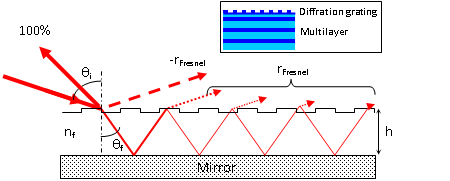
Fig.
Fresnel reflection mechanism on a mirror based
corrugated dielectric film: direct reflection, field
trapping, leaky mode propagation and re-radiation. The
corrugation balances the direct reflected and the
re-radiated field modulus ensuring 100% -1st
order efficiency. The inset represents the fabricated
all-dielectric multilayer grating structure.
Between
2002 and 2007 at University Jean Monnet in the group of Prof. O.
Parriaux, my work on the design, elaboration and
characterization of resonant gratings contributed to get the
following outstanding results:
-Demonstration of a 99 % diffraction efficiency in the first
order of a resonant diffraction grating [Destouches, Opt Exp
2005],
-Demonstration of a tunable narrow band filtering on a broad
range for a very small focused laser beam with a polarization
selectivity using an all-dielectric resonant grating
[Destouches, Opt Exp 2006],
-Demonstration of the use of a high reflectivity grating as an
intra-cavity element in a semiconductor disk laser (VECSEL) to
stabilize its emission wavelength and polarization
characterictics [Giet Opt Exp 2007],
-Demonstration of a high efficiency optical interconnect for a
multimode slab waveguide, the grating coupler strength being
enhanced by means of a leaky mode resonance [Destouches Opt Exp
2007].
From 2008, at the head of the "Nanoparticle" team, photochromic
materials, atomic force microscopy lithography, optical
properties of metallic nanoparticles assemblies and
self-organization became my main centers of interest in
research.
• Photochromic materials:
In 2003, the group of Prof T. Tatsuma in Tokyo demonstrated the
multicolored photochromism based on the reversible control of
the localized surface plasmon resonance of silver nanoparticles
in TiO2 matrices. The elaboration of mesoporous films of TiO2
and their use for such applications led us to demonstrate a
significant improvement in the stability of colored states of
such photochromic coatings. The poor sensitivity to ambient
light was achieved through a control of the porosity size. The
use of lasers provided to our systems three interesting
specificities: easy printing of micropatterns, better control of
the NP size, superimposing of updatable and permanent printings
on the same films [Crespo-Monteiro, Adv Mater 2010].
Further studies gave us opportunities to deeper explore the
subject and to:
-Demonstrate the laser-induced reversible multicolor
photochromism on mesoporous thin films with colored patterns
exhibiting a long lifetime [Nadar, J. Nanopart Res 2013],
-Use the photochromism for goods authentication
[Crespo-Monteiro, APE 2012],
-Visualize the shape changes of Ag nanoparticles under
laser-induced oxidation and demonstrate their sensitivity to
visible light intensity [Crespo-Monteiro, APL 2011],
-Demonstrate that very small Ag nanoparticles can be used as
laser-excited heat nanosources to control accurately the crystal
phase of the surrounding matrix and its density
[Crespo-Monteiro, J Phys Chem C 2012],
-Better characterize the phases and oxidation states of silver
present in the films during photochromic cycles and the
structural changes occurring in the TiO2 matrix
[Crespo-Monteiro, J Phys Chem C 2014].
-Deposite efficient photochromic films on polyethylene
terephthalate (PET) sheets with processes adaptable to industry.
Inkjet and flexography printing processes were adapted to a
titanium precursor solution previously formulated to fabricate a
mesoporous film of amorphous TiO2 on PET [Tricot, RSC Adv 2015,
Tricot JCTR 2018].
-Elaborate, in collaboration with Dr. L. Simonot from "Institut
Pprime" in Poitiers, France, efficient photochromic films by
reactive magnetron sputtering without external heating, a PVD
technique compatible with large-scale production, which also
enables the use of soft substrate materials like plastic or
paper [Diop Adv Mater Inter 2015, Diop Appl Spec 2016].
-Combine GISAXS and optical transmission measurements to gain a
better understanding of how photochromic responses in this
nanocomposite take place, which may reveal ways of optimizing
them [Babonneau NanoFuture 2018].
• Atomic force microscopy
lithography:
We developed an AFM-lithography technique based on the local
electrochemical reduction of silver salt contained in mesoporous
silica films [Hubert APL 2012]. We especially demonstrated the
reversible switching of silver nanostructures between the top
and bottom interfaces of the film and the creation of conductive
nanochannels though the film thickness [Bakhti J Phys Chem C
2014]. This study led to highlight a rapid and cost effective
technique to grow metallic nanorods at the apex of AFM tips,
which could be used as a new generation of high-quality sharp
tips for high resolution tip enhanced spectroscopy and
microscopy [Bakhti Nanoscale 2016].
• Optical properties of
metallic nanoparticles assemblies:
Simulating and understanding the optical properties of metallic
nano-objects embedded in thin films as those we produce with
lasers or AFM lithography requires using electromagnetic
modeling. We very recently developed a coupled mode modeling to
interpret in an original manner hybrid (sub-radiant,
super-radiant) modes and Fano resonances in plasmonic systems,
which draw much attention in recent years [Bakhti ACS Photonics
2015]. This work was based on an original representation of
plasmon-resonance modes with singular functions, which was fully
described and used to optimize the resonant behavior of
plasmonic systems exhibiting an arbitrary number of resonances
[Bakhti Plasmonics 2015]. We also developed an original
theoretical approach that provides an insightful analysis of the
mechanism at the origin of Fano-like resonances in plasmonic
oligomers. It especially provides a clear demonstration of the
role of coupling between magnetic and electric modes on the
resulting resonance [Bakhti Scientific Reports 2016].
• Self-organization:
A breakthrough that we recently proposed in the nanostructuring
of materials is the laser-induced self-organization of metal
nanoparticles in thin films. A paper fully describes the
conditions leading to the formation of periodic structures and
highlights the role of several parameters in the underlying
physical mechanisms. It also proposes a model, based on the
coupled mode theory, to predict the spontaneous generation of
such periodic nanostructures [Destouches J Mater Chem C 2014].
We then demonstrated that 2D self-organization paterns could be
produced either by combining two linear polarizations or by
using a circular polarization [Baraldi Nanotechnol 2017]. The
understanding of laser-induced self-organization processes is
far from being elucidated and modeling the intricated physical
and chemical processes that occur during laser exposure is a
fundamental part of my current and future works that could
contribute to shed light on this fascinating effect. One of our
recent papers has proposed model to take into account three
competitive chemical mechanisms into the laser-induced growth
model [Liu J Phys Chem C 2015] and to simulate the evolution of
the nanoparticle size distribution under the laser beam [Liu
PCCP 2016]. This work also led us to develop a
quantitative analysis process of STEM (scanning transmission
electron microscopy) images, in collaboration with Dr T.
Epicier at MATEIS laboratory, France, to precisely mesure the size
distribution of small
metallic nanoparticles (<5 nm) embedded in a
heterogeneous host matrix as mesoporous TiO2 [Liu J Micros
2017].
Our works
were the first in the literature to deal with the organization
of metallic nanoparticles at the embedded interface of an
optical waveguide. This specific configuration gives rise to
prominent and singular optical effects like linear [Destouches
JOSA B 2014] and circular dichroism [Wang OME 2018].
Recently, in collaboration with J. siegel from IO-CSIC, Spain,
we have explored the potential of femtosecond pulsed lasers in
such mechanisms in order to limit thermal effects and to offer a
solution to work on plastic substrates. Self-organization of
surfaces induced by ultra-short laser has been the subject of
many studies for fifty years on all types of materials for the
great opportunities of application it provides in areas as
diverse as cellular development, high resolution imaging or
friction reduction to name a few. In an article published in ACS
Nano [Liu ACS Nano 2017], we demonstrated for the first time
that two independent self-organization processes can be
initiated simultaneously in different planes within a thin
nanocomposite layer. This discovery, which paves the way for
three-dimensional nanostructuring, is used for the realization
of plasmonic nanostructures and the control of their color on
large surfaces by a fast, versatile and low cost technology.
|
Co-supervision of PhD students
|
2018-2021
Nicolas Dalloz, Exploring multiplexing of
high-density images by color and color effects, and its use in
the field of security and identity documents (grant from
HIDGlobal CID, co-supervisor Mathieu Hébert, Lab Hubert
Curien)
Balint Eles, In operando characterization of
laser induced transformations in nanostructured plasmonic
films(grant from UJM, co-supervisor Christophe Hubert, Lab
Hubert Curien)
2015-2019 Nipun Sharma,
Self-organization of metallic nanoparticles in TiO2
thin films: study of the physico-chemical mechanisms and
applications to photocatalysis (grant from regionRhône Alpes,
co-supervisor Guy Vitrant IMEP-LAHC). Left for HIDGlobal CID.
2013-2016 Zeming Liu,
Auto-organisation de nanoparticules métalliques dans des
guides d’ondes sous flux laser (grant from UJM, co-supervisor
Guy Vitrant IMEP-LAHC). Left for becoming an Innovation
Engineer at Parifex
Daouda Diop, Elaboration par pulvérisation
magnétron et caractérisation de couches minces photochromes
(Ag/TiO2) (grant from the ANR, co-supervisors Lionel Simonot
and David Babonneau Institut P prime). Left for becoming an R&D
Engineer
at Essilor
Fanny Tricot, Films nanostructurés
ré-inscriptibles sur supports souples (grant from the ANR,
co-supervisors Francis Vocanson LabHC and Didier Chaussy
LGP2). Left for a post-doc at LGP2.
2011-2014 Said Bakhti,
Etude théorique des résonances plasmon de nanostructures
métalliques et leur inscription lithographique par Microscopie
à Force Atomique (grant from the region Rhône Alpes,
co-supervisors Christophe Hubert and Alexandre Tishchenko
LabHC). Situation in 2018: engineer R&D at Mentor
Graphics.
2009-2012 Nicolas
Crespo-Monteiro, Photochromisme de films mésoporeux
d'oxyde de titane dopés argent appliqué au stockage de données
(grant from UJM, co-supervisor Aziz Boukenter LabHC).
Situation in 2018: assistant professor at Université Jean
Monnet
2008-2011 Latifa Nadar,
Surfaces fonctionnalisées à base de nanoparticules métalliques
pour l'optique et la photonique (grant from UJM, co-supervisor
Francis Vocanson LabHC). Situation after her thesis: work in
Lebanon
2006-2009 Yann Battie,
Mécanismes de croissance in situ et propriétés optiques de
nanoparticules d'argent spatialement organisées dans des films
diélectriques mésostructures (grant from région rhone alpes,
co-supervisor Aziz Boukenter LabHC). Situation in 2018:
assistant professor at Université de Lorraine
2004-2007 Janyce Franc,
Microstructuration de couches minces organo-minérales
élaborées par voie sol-gel : application à la réalisation d’un
dispositif pour l’interconnexion optique (grant from région
rhone alpes, co-supervisor Danièle Blanc LabHC). Situation in 2018: R&D manager at Claranor
|
Supervision
of Post-doc fellows
|
2016-2017 Marie
Vangheluwe, Laser-induced self-organization of metallic
nanoparticles: study of the physico-chemical mechanisms and
parameters to generate original effects on plastic substrates
(industrial contract with Arjo Systems), 18 months. Left
for a position of engineer at Arjo Systems
2015-2017 Said
Bakhti, In situ characterization of laser-induced
self-organized metallic nanoparticles (grant from ANR and
Lawrence Berkeley National Laboratory, USA), co-supervisor Ali
Belkacem, 19 months. Situation
in 2018: engineer R&D at Mentor Graphics.
2015-2016 Giorgio
Baraldi, Laser-induced nanoengineering of surfaces for
sensor and photocatalytic applications (grant from PALSE UdL),
18 months. Left for a post-doc in Spain
2014-2015 Said
Bakhti, Scattering by metallic nanoparticles in thin
films (grant from LABEX MANUTECH-SISE), 18 months
2012-2014 Renée
Charrière, Optimization of the laser-induced and
reversible colour writing of micro-nano-patterns (grant from
LABEX MANUTECH-SISE). Co-supervisor
Mathieu
Hébert LabHC. 18 months. Situation in 2018: assistant
professor at Ecole Nationale Supérieure des Mines de
saint-Etienne
2011-2012 Soma Biswas, Croissance réversible de nanoparticules
d'argent sous pointe AFM (grant from UJM). 12 months. Left for
post-doc at EPFL
2008-2010 Reine Sayah, Synthèse de couches méso-poreuses et
croissance de nanobâtonnets métalliques (grant from ANR and
UJM). 20 months. Left for a post-doc at CPE